
Epitomax® Behavioral Health Software:
ICD-10 Diagnosis Enhancements - Release 2
Epitomax® 8.0
Copyright © 2014 PsyTech Solutions Inc. Intended solely for use by PsyTech Solutions personnel, dealers, and customers. Note that the information in this document is subject to change without notice. Any unauthorized use, reproduction, or distribution of this material is strictly prohibited and punishable by law.
Contents
Staff Calendar Diagnosis
Indicators
Overview
Building on the initial February 2014 release of the ICD-10 diagnosis coding system into Epitomax©, we have added a number of enhancements to help you transition your staff and clients to ICD-10. This includes support for reporting both ICD-9 and ICD-10 codes when submitting claims and new features to assist you in coding your clients in ICD-10.
As you probably already know, ICD-10 diagnosis coding will be required for claiming services rendered on or after 10/1/15. Any service occurring prior to this date must be claimed using ICD-9 diagnosis coding, regardless of when the claim is submitted. Some implications of this transition are:
1. Claims of services rendered prior to 10/1/15 (including rebills) will still be claimed using ICD-9 codes, even if the claim is generated after 10/1/15.
2. Any admission that receives services before and after 10/1/15 will need to be dual coded in both ICD-9 and ICD-10 so that the correct diagnosis codes can be claimed.
3. ICD-10 coding of your admissions must begin and be completed prior to 10/1/15 to avoid a disruption in cash flow.
Epitomax© will handle claiming the correct coding system based on service date, and your staff will be responsible for coding clients in the correct code system.
We are excited to be partnering with you through this transition from ICD-9 to ICD-10. Please feel free to reach out to us when you have questions.
Diagnosis Work List
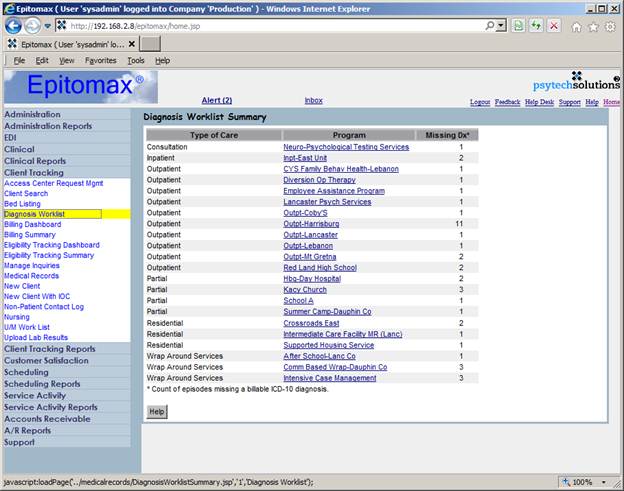
We created a Diagnosis Work List screen primarily to help you track coding your clients into ICD-10. From the summary view, you can see an overview of your organization and how many admissions still need ICD-10 coding. We have also provided a detail view with links to assist you in coding your clients.
Diagnosis Work List Summary
Diagnosis Work List Detail
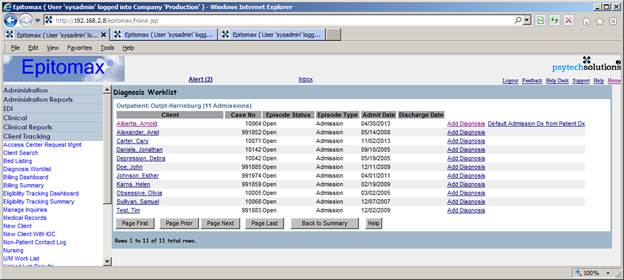
Click on one of the program links on the summary view to pull up the diagnosis work list detail view. From here you can:
1. Click on the client name link to pull up the patient level diagnosis screen.
2. Click on the “Add Diagnosis” link to bring up the admission level diagnosis screen.
3. Click the “Default Admission Dx from Patient Dx” link to default the admission diagnosis from what is already entered as the patient diagnosis.
Once you are finished making changes, you can click the “Back to Summary” button to go back to the summary view.
Diagnosis Report
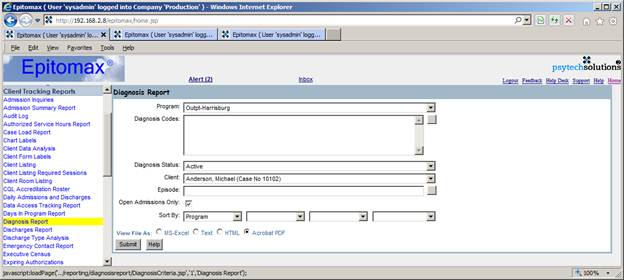
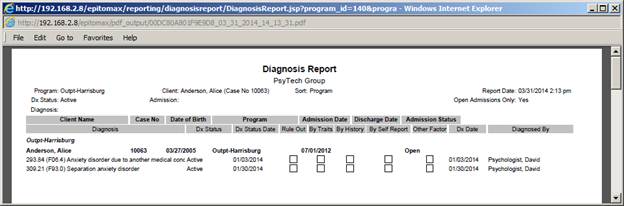
There is a new Diagnosis Report that you can use to view ICD-10 diagnosis coding in your organization. We have exposed a number of different criteria options to allow you to approach your data from a number of different angles.
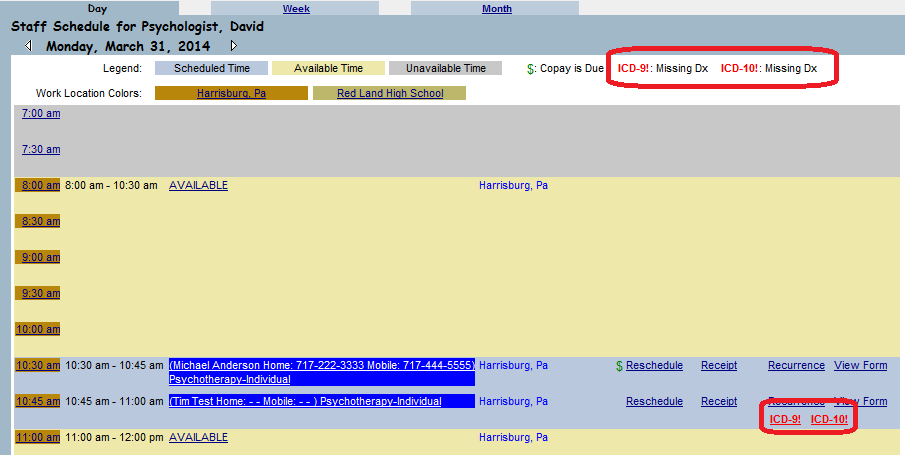
Staff Calendar Diagnosis Indicators
There are 2 new indicators on the staff schedule day view to help your staff with Diagnosis coding. Both of these indicators are links that open the appropriate diagnosis screen.
1. ICD-9!: Admission has not been coded in ICD-9.
2. ICD-10!: Admission has not been coded in ICD-10.
Billing Support for ICD-10
Epitomax© now supports submitting claims with ICD-10 diagnosis coding. Claims for services rendered prior to 10/1/15 will be generated with the client’s ICD-9 coding, and claims for services rendered on or after 10/1/15 will be generated with the client’s ICD-10 coding.
1. The billing error report that runs during charge generation and claim generation will check for valid diagnoses in the appropriate ICD versions depending on the date of service being claimed.
2. The CMS 1500 claim form has been updated to version 02/2012 which supports ICD versioning by date of service.
3. The UB-04 claim form already handles ICD versioning and the Epitomax© coding for this form has been updated to print the correct diagnosis depending on the date of service.
4. The 5010 837 electronic format already handles ICD versioning and the Epitomax© coding for this format has been updated to print the correct diagnosis depending on the date of service.
5.
Future Enhancements
PsyTech Solutions has identified enhancements to your clinical forms to not only support ICD-10 diagnosis coding but also improve clinical documentation workflows related to diagnosis coding. Our dedicated forms team will partner with you to make this a smooth transition. We have not determined a release date for this enhancement.